In this guide
E85 is the cheapest way to get more power out of a turbo car that's already on the edge of detonation on 98. It's also thirstier, harder to find and more expensive to set up than most people expect. For a boosted street car it's often worth it. For a naturally aspirated daily on a modest tune, it usually isn't.
Quick answer: A typical E85 or flex fuel conversion costs about $2,500 to $8,000 in 2026 (ballpark AUD, parts and tune). You'll use roughly 25 to 35 per cent more fuel, and E85 is only sold at a limited number of stations, mostly United. The payoff is big knock resistance, which turbo and supercharged cars can turn into a lot more safe power.
What E85 actually is
E85 is a blend of ethanol and petrol. Despite the name, the ethanol content isn't fixed at 85 per cent. Under Australia's national fuel quality standard for E85, ethanol content can sit anywhere in a band roughly between 70 and 85 per cent. That variation is why a flex fuel sensor matters.
Ethanol resists knock far better than petrol and has a strong cooling effect on the intake charge. On a forced-induction engine, that lets the tuner run more boost and timing safely. That's where the power comes from.
E85 conversion cost breakdown
| Part | Typical range (AUD, 2026) | What moves the number |
|---|---|---|
| Larger injectors | $600 to $1,800 | Brand, size, number of cylinders |
| Fuel pump (in-tank) | $250 to $900 | Single vs twin pump, hanger quality |
| Surge tank setup | $1,500 to $3,500 | Needed on bigger builds or cars with fuel starvation issues |
| Flex fuel sensor + fittings | $250 to $700 | Sensor brand, adaptor kit |
| Fuel lines, filter, regulator | $300 to $1,500 | Whether factory lines are E85 compatible |
| Wiring and install labour | $300 to $1,500 | Platform, workshop rate |
| Tune / flex calibration | $800 to $2,500 | Factory vs aftermarket ECU, extra dyno time |
Typical totals:
- Simple flex setup on a well-supported platform with a decent factory pump: $2,500 to $4,000
- Mid-level street turbo build: $4,000 to $6,500
- Big power build with surge tank and twin pumps: $6,500 to $10,000+
The pros
- More power on boosted cars. Knock resistance lets the tuner add timing and boost. Gains on turbo cars can be substantial; gains on a stock NA engine are usually small.
- Cooler, safer combustion. The charge-cooling effect gives you a buffer that 98 can't.
- Consistent tuning headroom. Many builders treat E85 as cheap insurance against detonation at high boost.
- Flex fuel flexibility. With a sensor, you can run 98 when E85 isn't around.
The cons
Availability
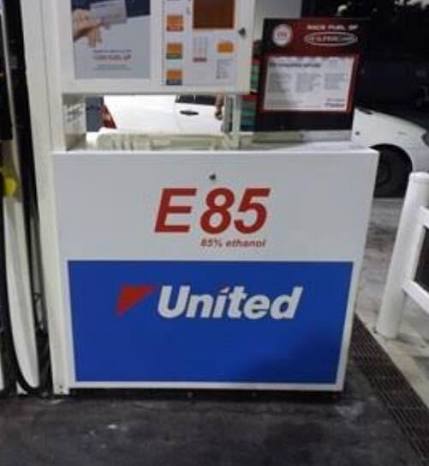
This is the big one in Australia. E85 is sold mainly through United, with fuel price trackers listing well under a hundred sites nationally as of 2026. Depending on where you live, your nearest bowser could be a long drive away. Rural and remote areas are often out of luck. Check a live fuel app for your area before you buy a single part.
Consumption
Expect roughly 25 to 35 per cent more fuel than on petrol. Range drops noticeably, which matters if E85 stations are sparse near you.
Price
E85 is no longer the bargain it once was. Recent pricing has often been close to, or sometimes above, premium unleaded per litre, and because you burn more of it, cost per kilometre is usually higher. Check current prices in your area rather than assuming it's cheaper.
Content variation
Ethanol content shifts between batches and seasons. Without a flex sensor, a car tuned for one blend can run lean or rich on another.
Fuel system wear
Ethanol is harder on some older rubber lines, seals and fuel system parts. Older cars may need fuel lines and components replaced with ethanol-compatible parts.
Cold starts
High-ethanol blends can be harder to start in cold weather. A good tune helps, but it's worth knowing if you live somewhere that gets frosty.
Running E85 day to day
A few habits make life on ethanol easier:
- Plan your fills. Know where your nearest two or three E85 stations are, and don't let the tank run low when you're away from them.
- Keep an eye on the ethanol reading. If your flex sensor shows a big swing from one fill to the next, mention it to your tuner.
- Don't let it sit for months. Ethanol absorbs moisture. If the car is stored for long periods, many owners leave it on petrol or a lower blend.
- Carry on servicing normally. Check fuel filters more often in the first few months after converting, as ethanol can loosen deposits in an older tank.
Who should convert to E85?
Worth it for:
- Turbo and supercharged cars chasing more power
- Builds where 98 is limiting timing or boost
- Weekend and event cars near a reliable E85 supply
Probably not worth it for:
- Naturally aspirated cars on a mild tune
- Daily drivers that rack up long kilometres
- Anyone more than a short detour from an E85 station
Engineering, insurance and the law
Fuel system changes and the power gains they enable can be relevant for engineering, especially when combined with a turbo conversion, engine swap or big power increase. Read What Car Mods Need Engineering in Australia and check with your state authority or a licensed engineer if you're unsure. Declare the conversion to your insurer as well.
Planning the rest of the build
E85 rarely happens on its own. It's usually part of a turbo upgrade or power target. For full budgets, see How Much Does It Cost to Turbo an LS? and 300kW, 400kW, 500kW: What Each Power Level Really Costs. And because flex fuel adds dyno time, read Dyno Tuning: What It Costs and What to Expect before booking.
Find a tuner who has done flex fuel on your platform:
Or skip the build and buy a car that's already sorted on E85:
Frequently asked questions
How much does an E85 conversion cost in Australia?
Ballpark as of 2026, most street car E85 or flex fuel conversions cost $2,500 to $8,000 including parts and tuning. Simple in-tank setups on well-supported platforms sit at the low end; surge tanks, twin pumps and new fuel lines push it higher.
Where can you buy E85 in Australia?
E85 is sold at a limited number of service stations, mostly through the United network, with fuel price trackers listing under a hundred sites nationally as of 2026. Check a live fuel app for your area before converting.
How much more fuel does E85 use?
Expect roughly 25 to 35 per cent more fuel than petrol, because ethanol carries less energy per litre. Your range drops accordingly.
Do I need a flex fuel sensor for E85?
For a street car, it's strongly recommended. Ethanol content at the pump can vary, and a flex sensor lets the ECU adjust fuelling and timing automatically so you can run E85, 98 or a mix.